The Technology Pillar
Most companies don't have an AI stack. They have AI features bolted onto yesterday's processes.

The Technology Pillar
Everyone is talking about AI. Copilots, agents, autonomous workflows. But when we sit down with the founders, CTOs and ops leaders actually running fast-scaling companies, the reality looks nothing like the LinkedIn posts.
People in over 90 percent of companies are using AI tools at work today. The trouble is that almost none of those companies can answer the only question that actually matters: where exactly is my business today, and what's the next move?
That's the job of the Dragonfly AI Readiness Framework. It evaluates a business not by how many tools it owns, but by how much human effort is still required to move work from one step to the next inside its core processes. Across that mapping work, in sales, support, engineering, HR, finance and marketing, one pattern repeats: most scaling companies are stuck somewhere between digitised and automated, nowhere near ready to unlock what AI can actually do for them.
Download the full PDF resource
Enter your email address below to unlock the downloadable PDF version of this resource.
Thank you! Click below to download your PDF.
Download PDFThree pillars, one honest diagnostic
The framework looks at readiness through three pillars.
Technology asks whether the tools at each stage of your core processes are actually doing the work, or whether your team is silently filling the gaps between them with copy-paste, side spreadsheets and end-of-day catch-ups.
People is about what happens after the tools are in. If you've shipped AI to your team and watched most of them drift back to their old workflows within weeks, the People pillar explains why that isn't an adoption problem at all, and what has to shift underneath for any of the tools to actually stick.
Strategy is what holds the other two together. If your AI strategy was greeted with applause at the offsite but you can't name a single thing it has changed in the business since, the Strategy pillar lays out the decisions any real strategy has to commit to, the ones most leadership teams quietly skip.
Most companies don't have an AI stack. They have AI features bolted onto yesterday's processes.
CoFounder of Dragonfly
Inside the Technology paper, a first look
This summary covers paper one of three, the Technology pillar. It comes first for a reason. People won't adopt tools that don't fit how their work actually flows, and no strategy can compensate for a stack that's quietly held together by human effort. Before you can change the work, you have to see it clearly. That's what the Technology pillar is for.
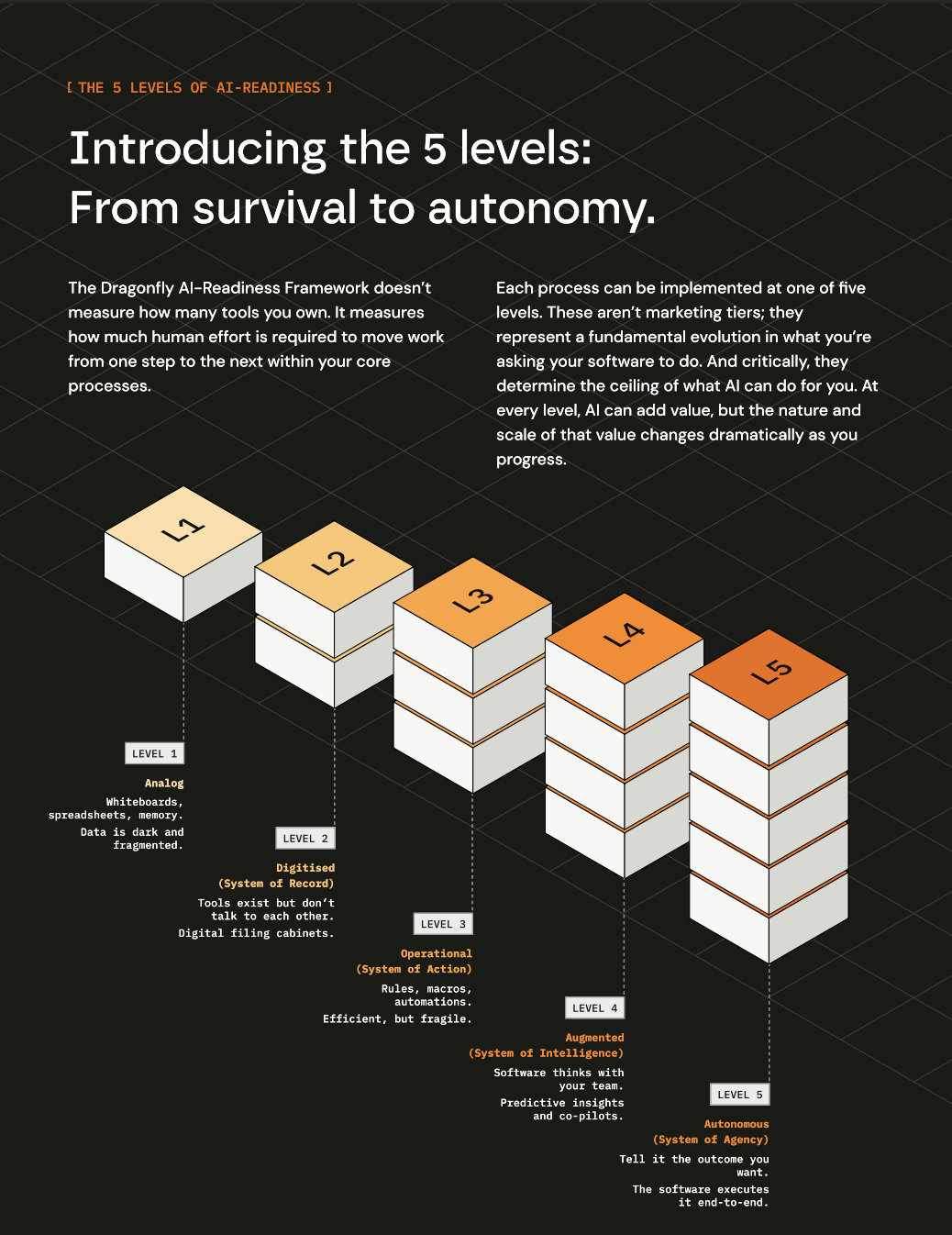
Within Technology, every core process in your business sits at one of five readiness levels. These aren't marketing tiers. They represent a fundamental evolution in what you're asking your software to do, and they determine the ceiling of what AI can deliver for you.
- Level 1, Analog. Whiteboards, spreadsheets, and people remembering things in their heads.
- Level 2, Digitised. Systems of record. CRMs, ERPs and helpdesks that store information but don't move it.
- Level 3, Operational. Rules and macros stitching tools together. Efficient, but fragile.
- Level 4, Augmented. Software that thinks with your team. Predictive insights, copilots, context-aware workflows.
- Level 5, Autonomous. Software that runs end to end. You set the outcome, the system does the work, and only loops in humans when judgement is actually required.
AI adds value at every level. But the magnitude compounds as you climb. A company stuck at Level 2 is leaving most of AI's potential on the table, not because they lack ambition, but because their infrastructure can't support it.
The trap: everyone thinks they're at Level 4
Almost every leadership team we sit with believes they're already operating at an advanced level. They have a CRM. They have dashboards. They've rolled out a copilot, maybe experimented with agents. So they assume they're AI-ready.
But when we map the real flow of work, the picture changes fast. Data is still being copied between systems by hand. Decisions still live in people's heads. Automation exists, but it's brittle. A patchwork of if/then rules duct-taped across tools that were never designed to work together.
That's Level 2 and Level 3 behaviour wearing a Level 4 badge. It's also exactly where most AI projects quietly fail.
AI doesn't fix broken processes. It exposes them.
Layering intelligence on top of fragmentation doesn't transform anything. It just makes the cracks faster and more visible. The real work isn't choosing better AI. It's seeing your processes clearly enough to know which ones can actually carry intelligence, which ones need to be redesigned first, and which ones are being held together by nothing but human patience.
That diagnostic, applied to your business, is what the rest of the Technology paper delivers.
What's in the full paper
What you've just read is the framework in outline. It's the part that fits in a website summary. The paper itself is where the framework becomes a tool you can actually use, and that's the part that changes how you spend the next twelve months. The summary makes the case. The paper makes the difference. Inside, you'll find:
- The full anatomy of each of the five levels: what AI can and can't realistically do at each, why the ROI equation flips between Level 3 and Level 4, and where most companies actually sit, which is rarely where they think they sit.
- The decision framework for when Level 5 is the right call and when chasing it is a mistake. Moving every process to autonomy isn't the goal, and treating it as one is as misguided as buying tools without a strategy.
- Worked examples for outbound sales and customer support, mapping the exact stages, tools and metrics that shift as you climb the framework.
- How Dragonfly's AI Readiness Platform turns the framework into a live benchmark of your specific stack against the best alternatives in the market, so you stop guessing and start comparing.
If you stop reading at the summary, you'll have a sharper way of talking about AI readiness. If you read the paper, you'll have a sharper way of running the business.
The next generation of companies won't win by owning more software. They'll win by evolving faster than their market, and that journey starts with brutal clarity about how your business actually runs today.
Download the full paper to see where yours stands.
AI doesn't fix broken processes. It exposes them.
Explore more resources
Blog
The People Pillar
AI doesn't replace your team. It rewrites their job description.
Sean King
June 22, 2026
0
min read
The People Pillar
Here is a test worth running on your own company. Find the team that has taken to AI most enthusiastically: the highest usage, the stickiest tools, the greenest dashboard. Now picture switching all of it off tomorrow. Would their work actually change? Or would they be a little slower for a week, and then carry on exactly as they did before?
For most companies, the honest answer is the second one. And it is the single most important thing leadership doesn't yet know about its own AI rollout.
That gap, between a tool that gets used and a business that genuinely changes, is what this paper is about. Because the uncomfortable truth sitting underneath every green dashboard is this: usage is not adoption. People can open a chatbot every day, hit every prompt quota and rate the tool nine out of ten, and still do their jobs the exact way they did two years ago. Activity is easy to count. Change is the thing that matters, and it barely registers on any dashboard a vendor will sell you.
What follows is the shape of that argument. The paper is where it becomes a diagnostic tool: a way to see where each team really stands, tell real change from activity that just looks busy, and find the next move that turns AI from something your people use into the way they work.
Inside the People paper, a first look
Most people will read the title and assume this is a paper about training, communities of practice and change management. It isn't.
The reframe at the centre of it is simple. Your people are not the audience for AI. They are the operating system it runs on. Every workflow you have is implemented through human beings: their judgement, their relationships, the institutional knowledge held in their heads, the incentives they respond to, the rituals they have built around the work. AI does not sit politely on top of that layer. It rewires it.
Which is why training rarely moves the needle. You can teach prompting all day. But if nobody has told a person what their job becomes once a model can do the part they were hired for, you haven't answered the only question they are actually asking:
The three stances: Permitted, Embedded, Reconfigured
Across the companies we've mapped, that rewiring lands in one of three places. We call them stances, because a stance is something you can observe rather than something you can claim. Each one is defined by what has structurally changed in how the work gets done, not by what was said at the all-hands. And it is almost always a step behind where leadership believes the company sits.
- Permitted. AI is allowed, and almost nothing else has changed. The tools are in, a policy exists, a handful of power users are doing real work. But the org chart, the targets and the rituals are untouched. This is where most companies are today, and it hides comfortably behind a busy usage dashboard.
- Embedded. The practice has changed, even if the job description hasn't caught up. Teams share prompts and Skills, build AI into how they review and decide, and managers can name their power users. It is a transitional state. Companies either lock it in or slide back the moment the early believers move on.
- Reconfigured. The job itself has been rewritten around what AI cannot do: judgement under uncertainty, relationships, accountability, taste, the hard edge cases. Roles, targets, hiring and career paths all assume AI is a teammate, not a tool. Very few organisations are here yet.
The quickest tell: ask someone to describe their job today, then to describe it two years ago. At Reconfigured, the two answers sound like different jobs. At Permitted, they are the same job with "and I use AI sometimes" added to the end.
The trap: a flat dashboard looks like resistance
When adoption stalls, the easy story is that people are dragging their feet. They are not. What looks like resistance is almost always a rational response to a question the organisation has left unanswered.
Think about what AI does to a role. It absorbs the very work a person was hired for, promoted on and measured against. Leave their targets and incentives pointing at that same work, now that a model does it in seconds, and you have quietly asked them to make themselves redundant on paper while still hitting the old numbers. No training session resolves that. A flat dashboard isn't your people refusing to change. It is the organisation changing what its tools can do without changing what it asks of, or rewards in, the people using them.
What looks like resistance is almost always a rational response to a question no one has answered.
What's in the full paper
Everything above is the argument in outline. The paper is where it turns operational. Inside, you'll find:
- The three forces that keep the dashboard flat, identity, incentives and leadership, and why each one survives every training programme you throw at it.
- Worked examples from Finance and Operations, following real roles across all three stances, down to how a single job title can describe two completely different jobs.
- A way to measure change instead of activity. Licences, prompts and self-reported "hours saved" look the same whether AI is transforming the business or sitting idle. The paper sets out the questions that tell the two apart, at the level of the business, the team and the individual.
- Why culture is the precondition the rest of it depends on, and the one call leadership cannot delegate to anyone else.
- How Dragonfly reads the stance and the friction beneath the usage: which teams have genuinely changed how they work, where everyday practice and company policy are pulling apart, and where the people driving your progress are being backed or quietly lost.
Read the summary and you'll have a sharper way of talking about AI. Read the paper and you'll have a sharper way of running the business.
The companies that reach Reconfigured won't be the ones with the biggest AI budgets. They'll be the ones that built the new way of working into how work actually gets done, rewrote the roles before the market forced their hand, and backed the right people while they still had them.
Where this sits: the three pillars
This is the second of three. Dragonfly's AI Readiness Framework stands on three pillars, and they only pay off together. Technology asks whether your tools are actually doing the work, or whether your people are quietly holding them together. People, this paper, asks what happens once those tools are in. Strategy, still to come, is where the two get aligned: where to point AI, what it should be solving, and which trade-offs to make as the ground keeps shifting from one week to the next.
They're built to be read together. If you haven't yet, start with the Technology pillar, the ground everything here is built on. Read all three and you see the whole machine, not a single gear of it.