The Five Levels of AI Readiness (And Why Everyone Thinks They're Level 4)
This is Part 2 of our three-part series on AI Readiness. Part 1 covers why AI readiness is a stance, not a purchase. Part 3 explores How Dragonfly Benchmarks Your Stack Against 250,000 Vendors.

The Five Levels of AI Readiness (And Why Everyone Thinks They're Level 4)
Most companies measure their AI maturity by counting tools. How many copilots have we deployed? Are we using an AI-powered CRM? Do we have an automation platform?
That's the wrong question.
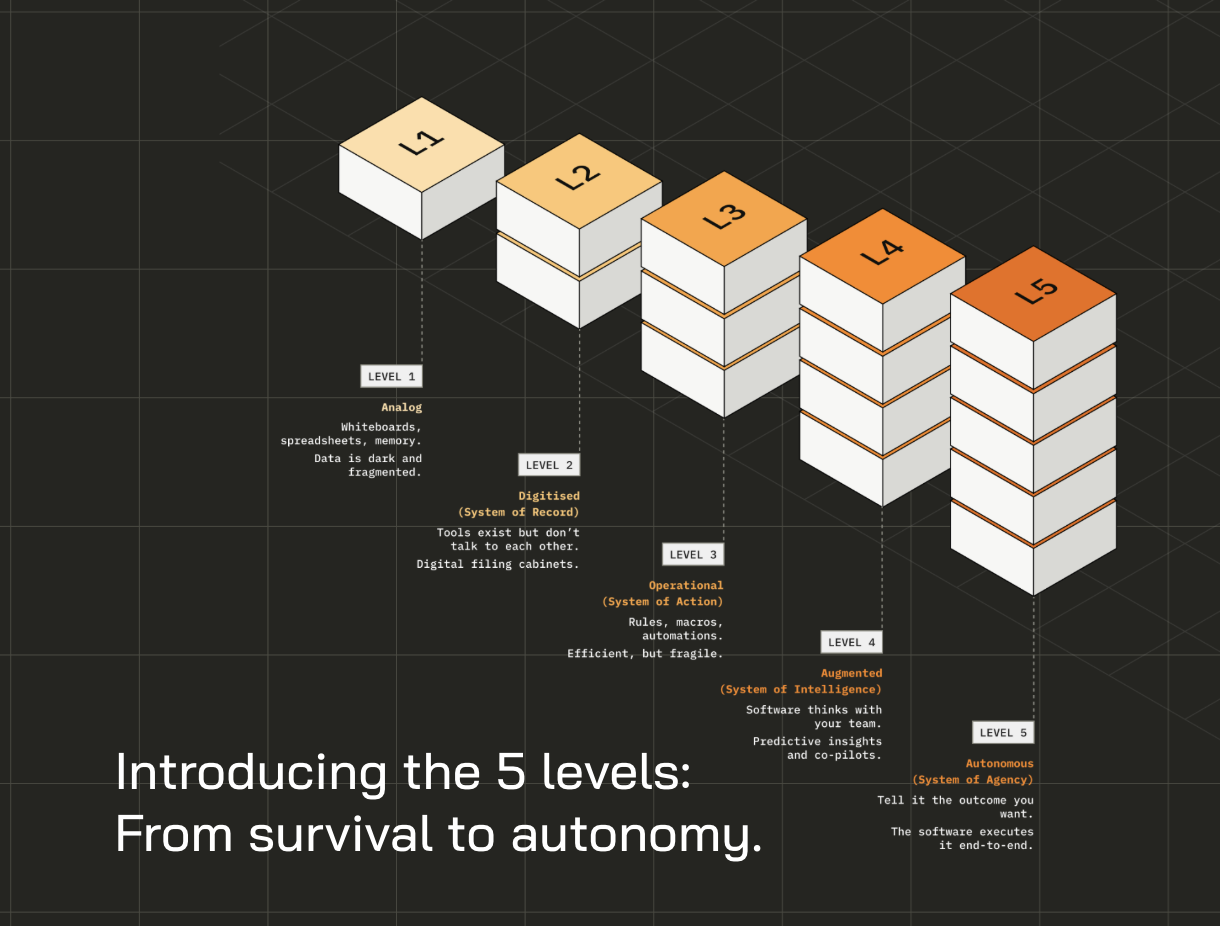
The Dragonfly AI Readiness Framework doesn't measure how many tools you own. It measures how much human effort is required to move work from one step to the next within your core processes. Each process can be implemented at one of five levels. These aren't marketing tiers, they represent a fundamental evolution in what you're asking your software to do.
And critically, they determine the ceiling of what AI can do for you. At every level, AI can add value, but the nature and scale of that value changes dramatically as you progress.
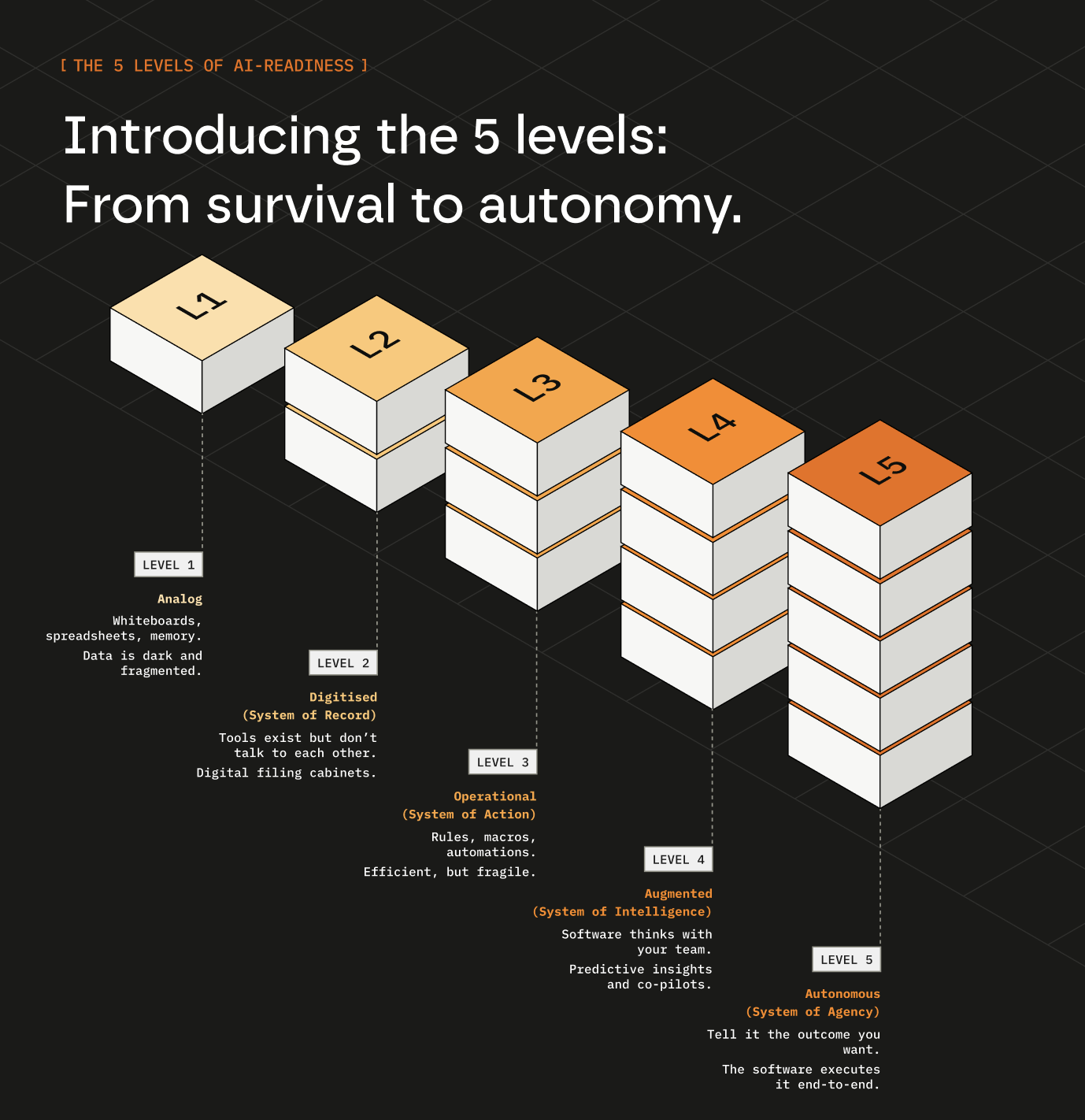
The five levels of AI Readiness
Download the full PDF resource
Enter your email address below to unlock the downloadable PDF version of this resource.
Thank you! Click below to download your PDF.
Download PDFLevel 1 — Analog (Survival)
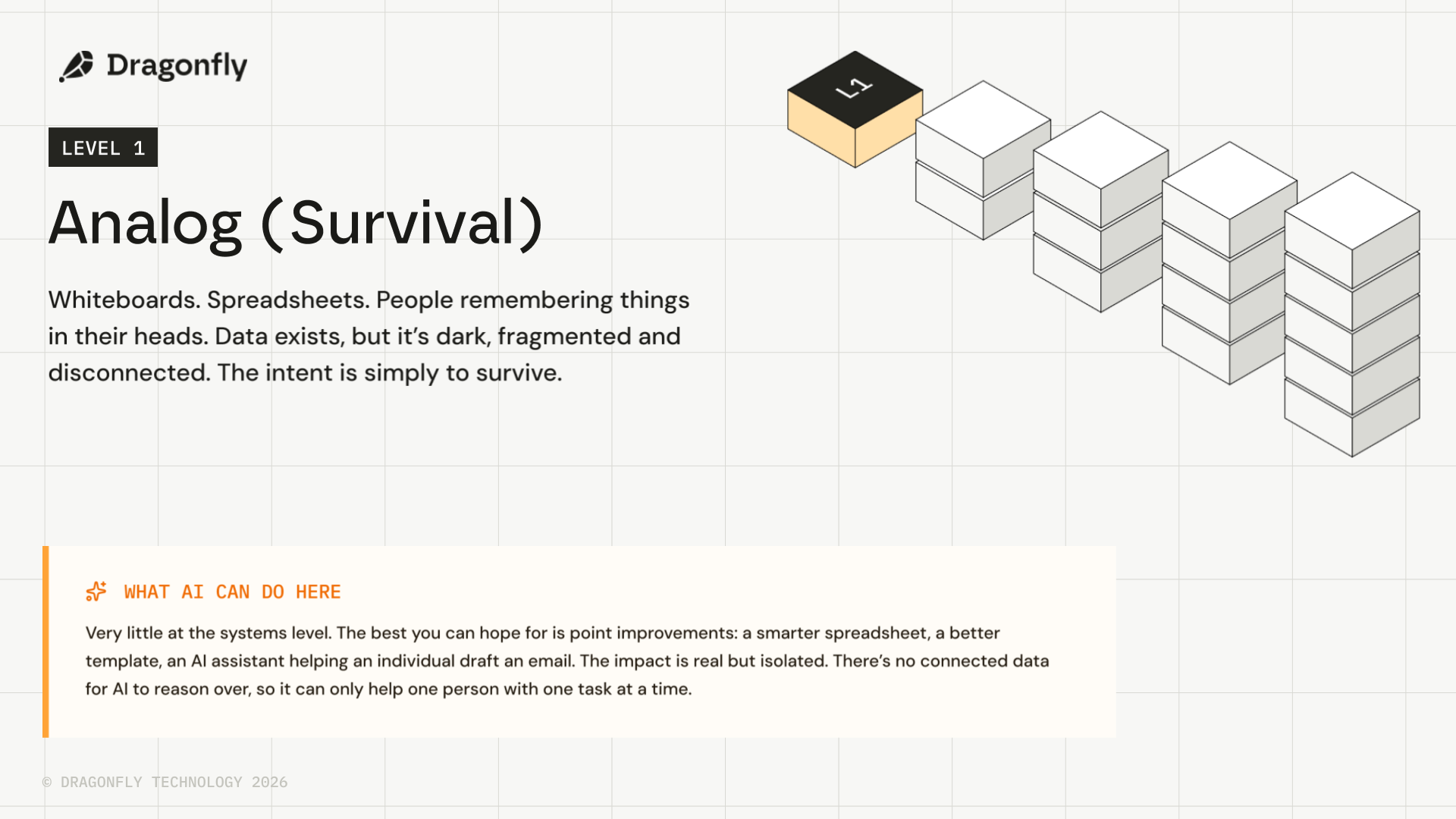
Whiteboards. Spreadsheets. People remembering things in their heads. Data exists, but it's dark, fragmented and disconnected. The intent is simply to survive.
What AI can do here: Very little at the systems level. The best you can hope for is point improvements; a smarter spreadsheet, a better template, an AI assistant helping an individual draft an email. The impact is real but isolated. There's no connected data for AI to reason over, so it can only help one person with one task at a time.
Level 2 — Digitised (System of Record)
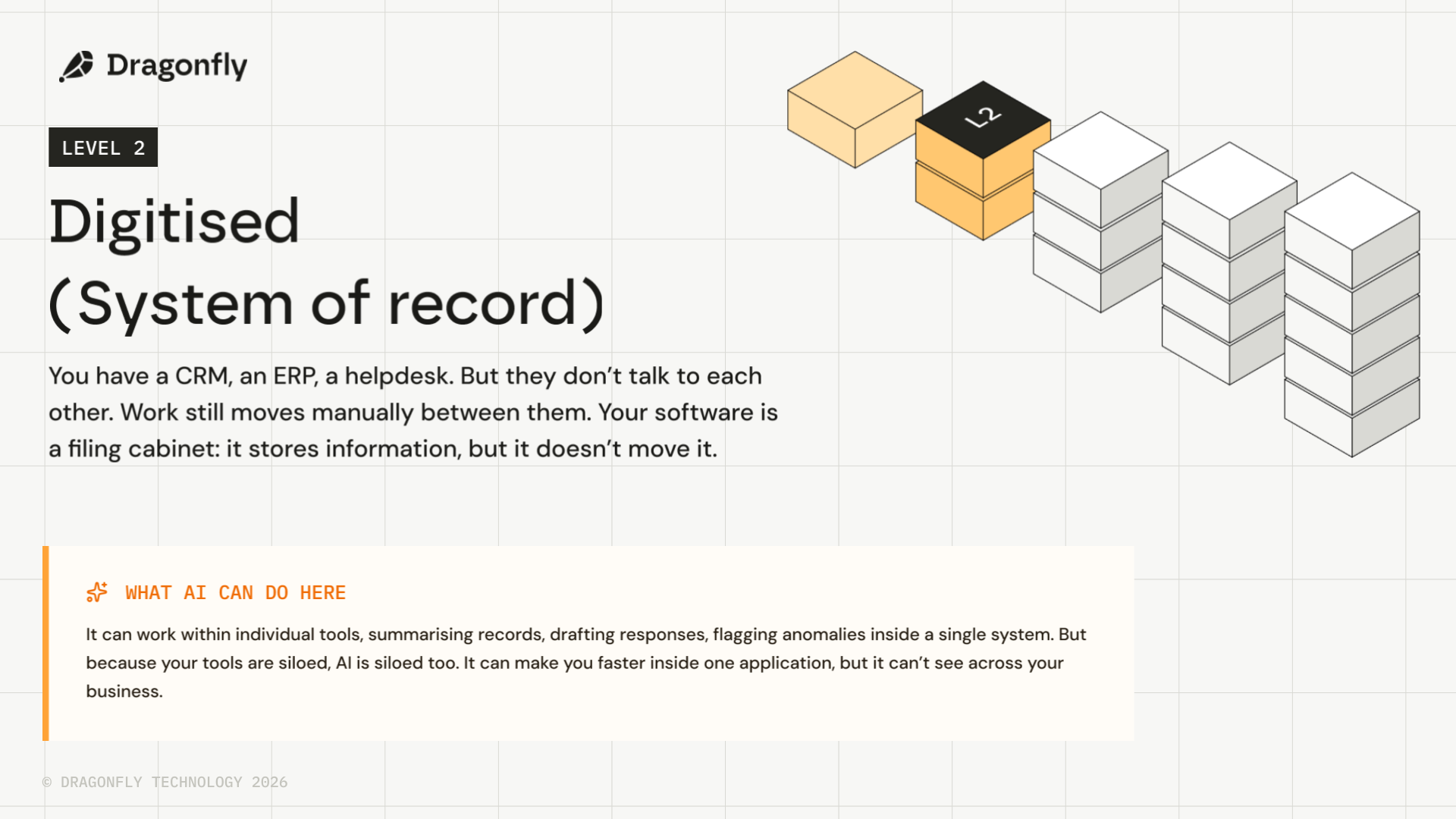
You have a CRM, an ERP, a helpdesk. But they don't talk to each other. Work still moves manually between them. Your software is a filing cabinet, it stores information, but it doesn't move it.
What AI can do here: It can work within individual tools, summarising records, drafting responses, flagging anomalies inside a single system. But because your tools are siloed, AI is siloed too. It can make you faster inside one application, but it can't see across your business.
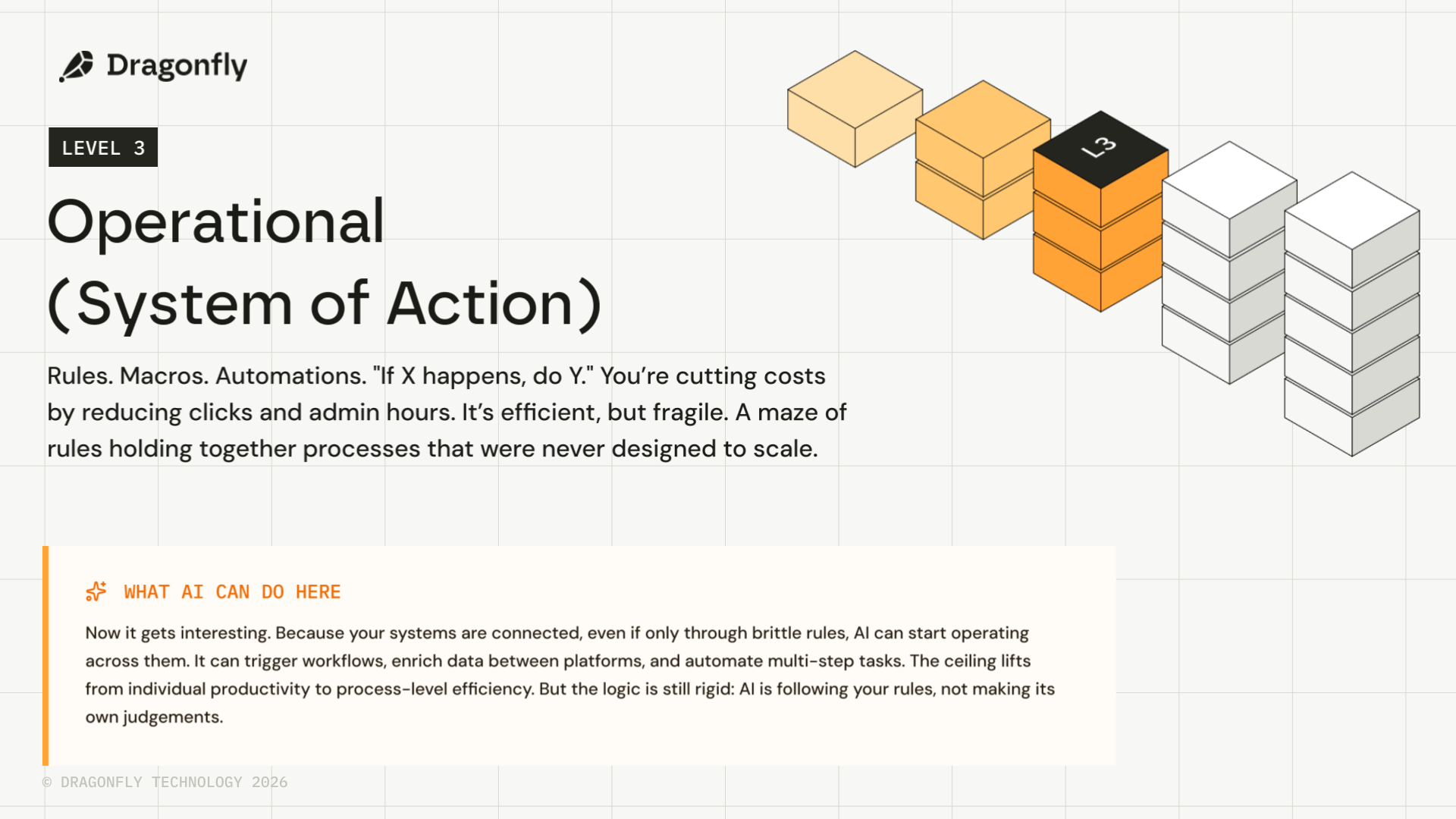
Level 3 — Operational (System of Action)
Rules. Macros. Automations. "If X happens, do Y." You're cutting costs by reducing clicks and admin hours. It's efficient, but fragile. A maze of rules holding together processes that were never designed to scale.
What AI can do here: Now it gets interesting. Because your systems are connected, even if only through brittle rules, AI can start operating across them. It can trigger workflows, enrich data between platforms, and automate multi-step tasks. The ceiling lifts from individual productivity to process-level efficiency. But the logic is still rigid: AI is following your rules, not making its own judgements.
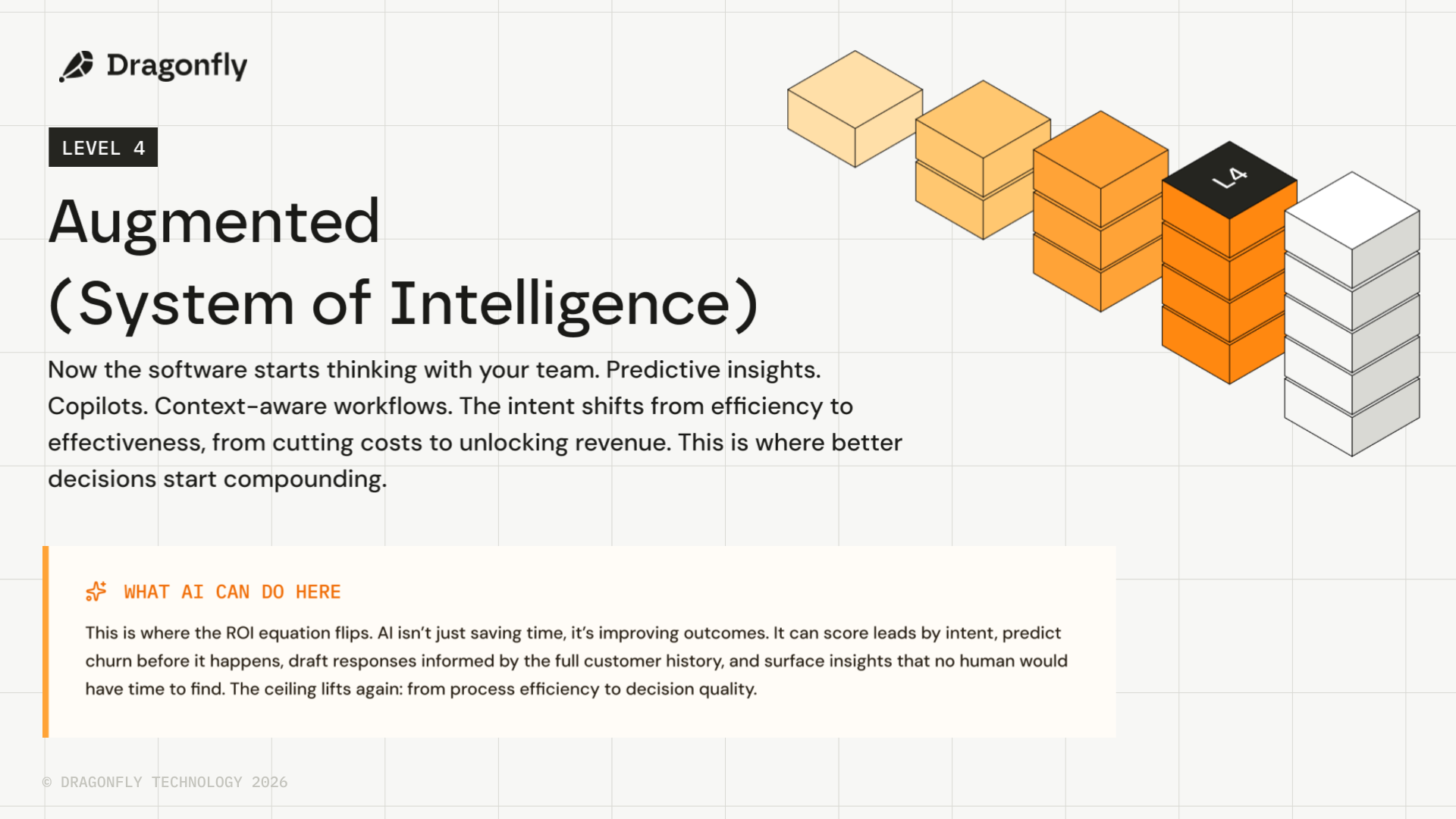
Level 4 — Augmented (System of Intelligence)
Now the software starts thinking with your team. Predictive insights. Copilots. Context-aware workflows. The intent shifts from efficiency to effectiveness, from cutting costs to unlocking revenue. This is where better decisions start compounding.
What AI can do here: This is where the ROI equation flips. AI isn't just saving time, it's improving outcomes. It can score leads by intent, predict churn before it happens, draft responses informed by the full customer history, and surface insights that no human would have time to find. The ceiling lifts again: from process efficiency to decision quality.
Level 5 — Autonomous (System of Agency)
The real leap. You don't tell the system what to do, you tell it the outcome you want. "Resolve this ticket." "Book qualified meetings." "Ship this feature." The software executes the workflow end-to-end, only looping in humans when it genuinely needs judgement.
What AI can do here: Everything. The entire process runs autonomously, AI plans, acts, evaluates, and adjusts. Humans set goals and handle edge cases. The ceiling isn't efficiency or even decision quality, it's capacity. Your business can operate at a scale that was previously impossible without proportional headcount.
The ceiling at every level is different. Level 1 AI helps one person. Level 5 AI runs your business. The infrastructure you build today determines which ceiling you're working under.
The Compounding Gap
The point isn't that Level 5 is the only place where AI matters. AI adds value at every level. But the magnitude of that value compounds as you move up. A company stuck at Level 2 is leaving 90% of AI's potential on the table, not because they lack ambition, but because their infrastructure can't support it.
And here's the uncomfortable truth: almost every leadership team we speak to believes they're already at Level 4. They have a CRM. They have dashboards. They've rolled out a copilot, maybe experimented with agents.
But when we map their real workflows, the picture changes fast. Data is still being copied between systems by hand. Decisions still live in people's heads. Automation exists, but it's brittle, a patchwork of if/then rules duct-taped across tools that were never designed to work together.
That's Level 2 and Level 3 behaviour wearing a Level 4 badge.
AI doesn't fix broken processes. It exposes them.

What This Looks Like in Practice
The framework isn't theoretical. We've mapped concrete processes for every major business function, the exact sequence of stages, the specific tools at each readiness level, and the metrics that shift as you move up. Here are two examples.
Outbound Sales: The Pipeline Chain
The Process: Identification → Enrichment → Outreach → Interaction → Closing
At Level 3, the goal is volume. High volume, low cost per touch. You're running Apollo for bulk lead export, a virtual assistant from Upwork doing manual research, Outreach.io firing static email sequences, and DocuSign closing deals with standard templates. The metric you care about is cost per meeting. It works, until it doesn't.
At Level 4, the goal shifts to conversion. You're using 6sense or UserGems for intent data and job-change signals, Clay to orchestrate enrichment from 50+ data sources, Gong for revenue intelligence and deal health analysis. The metric shifts to average contract value. You're not sending more emails, you're sending better ones to better people.
At Level 5, the pipeline builds itself. Clay's Claygent autonomously scrapes websites to qualify fit. 11x.ai or Artisan's Ava sends, replies, and books meetings without human involvement. HeyGen generates personalised video outreach on the fly. Ironclad AI auto-redlines buyer contract changes against your company playbook. The system runs while you sleep.
The gap between Level 3 and Level 5 isn't just about better tools. It's a fundamentally different relationship between your team and your software.
Customer Support: The Resolution Chain
The Process: Inbound Capture → Triage & Routing → Agent Response → Resolution → Feedback Loop
At Level 3, you've consolidated onto Zendesk with keyword routing rules, canned macros for responses, and an automated CSAT survey after ticket close. The metric is deflection rate, how many tickets can you prevent from reaching a human? It's cost-cutting through consolidation.
At Level 4, support becomes a retention engine. Forethought surfaces knowledge base articles before a ticket is even created. Zendesk Intelligent Triage detects sentiment and intent. Fin from Intercom drafts replies based on support history for agent approval. Salesforce Service Cloud gives your agent a single-pane view of customer lifetime value. The metric shifts to net revenue retention.
At Level 5, issues are resolved without a human touching them. Sierra or Decagon handles the conversational dialogue. Tines connects the AI to your database and systems of record. Stripe or Shopify gets updated automatically. Arize Phoenix monitors the LLM in real time for hallucinations. The customer's problem is solved end to end by the system.
The motto at Level 5 is simple: let AI work for your customers, not just for your employees.
So How Do You Actually Move Up?
Knowing your level is the first step. But a score without a path forward is just a number.
The real question is: what do you actually change? Which tools do you swap? Which integrations do you build? Which processes need to be redesigned before any AI investment will stick?
That's what Dragonfly was built to answer.
AI doesn't fix broken processes. It exposes them. Most companies are operating 1–2 levels below where they think they are.
Explore more resources
Blog
Stop buying AI tools. Start building an AI-Ready company.
This is Part 1 of our three-part series on AI Readiness. Part 2 dives into 'The Five Levels of AI Readiness', followed by part 3 which explores How Dragonfly Benchmarks Your Stack Against 250,000 Vendors.
Sean King & Sven Sabas
March 1, 2026
0
min read
Everyone is talking about AI, copilots, agents and building autonomous workforces... well at least they are on LinkedIn
Everyone is talking about AI. Copilots. Agents. Autonomous workflows. But when we sit down with companies, Founders, CTOs, Ops Leaders; the reality looks nothing like the LinkedIn posts we read every day.
Most aren't blocked by a lack of tools. They're blocked by the way their business is built.
At Dragonfly, we've spent the last year mapping thousands of tech stacks across sales, support, engineering, HR, finance and marketing. What we've learned is blunt:
You don't become AI-ready by buying AI tools. You become AI-ready by changing how work flows through your company.
AI Readiness Is a Stance, Not a Purchase
Put differently: AI readiness is a stance, not a purchase. What is your organisation's posture towards this shift? What have you actually put in place, or changed, to enable this transition? If the answer is "we bought some new tools but nothing else is fundamentally different," you have the wrong stance. The tools will underperform, the investment will stall, and six months from now you'll be wondering why the AI revolution passed you by.
That's why we built the Dragonfly AI Readiness Framework; a new way to measure where your business actually is today, and what it will really take to move forward. The framework evaluates readiness across three pillars:
Technology — are you using the right tools for each stage of your core processes, or are you running yesterday's stack and expecting tomorrow's results?
Strategy — do you have clear direction on what AI should be doing for your business? Do you have policies for data use, risk mitigation, and fair use or are your teams experimenting in the dark?
People — are your teams equipped to work alongside AI? Are you building literacy, sharing knowledge, and creating a culture that actually adopts what you're investing in?
Today we're launching the first pillar of that framework: a technology benchmark that scores your tooling stack against the best in the market, department by department.
Your Software Is Not a Set of Tools. It's How Your Business Runs.
Before we get into the framework, we need to reframe how you think about your tech stack.
Across every team in every company, the same basic pattern exists. A customer is found. A task is created. Someone takes action. A result is delivered.
We call that pattern a process, the fundamental sequence of steps required to turn intent into outcome. Your software stack is simply how you choose to implement that process.
This distinction matters because most companies treat software as utility, a tool you buy to do a job. But software isn't a utility. It's the implementation of a process. And if you don't understand the process underneath, you can't evaluate whether the tools on top are helping or hiding the problem.
You don't become AI-ready by dropping AI into this flow. You become AI-ready by understanding how these processes really operate today, where humans are compensating for broken systems, where data gets lost, and where automation is pretending to be intelligent.
The Problem Nobody Wants to Admit
Almost every leadership team we speak to believes they're already operating at an advanced level. They have a CRM. They have dashboards. They've rolled out a copilot, maybe experimented with agents.
So they assume they're "AI ready."
But when we map their real workflows, the picture changes fast. Data is still being copied between systems by hand. Decisions still live in people's heads. Automation exists, but it's brittle, a patchwork of if/then rules duct-taped across tools that were never designed to work together.
You can't layer intelligence on top of fragmentation and expect transformation. You just end up with chaos, a lot more noise and more surface-level automation masking deeper structural problems.
AI doesn't fix broken processes. It exposes them.
The first step is understanding where you actually stand. Not in terms of how many tools you own, but in terms of what your software is really doing for you, and what it could be doing if your processes were built to support it.
In Part 2 of this series, we break down [The Five Levels of AI Readiness], what AI can actually do for you at each level, and why most companies are two levels lower than they think. We also walk through real examples in Outbound Sales and Customer Support to show what each level looks like in practice.